
Why heel pain is worst with your first steps in the morning
Every claim in this article is linked to a published source, listed at the end.
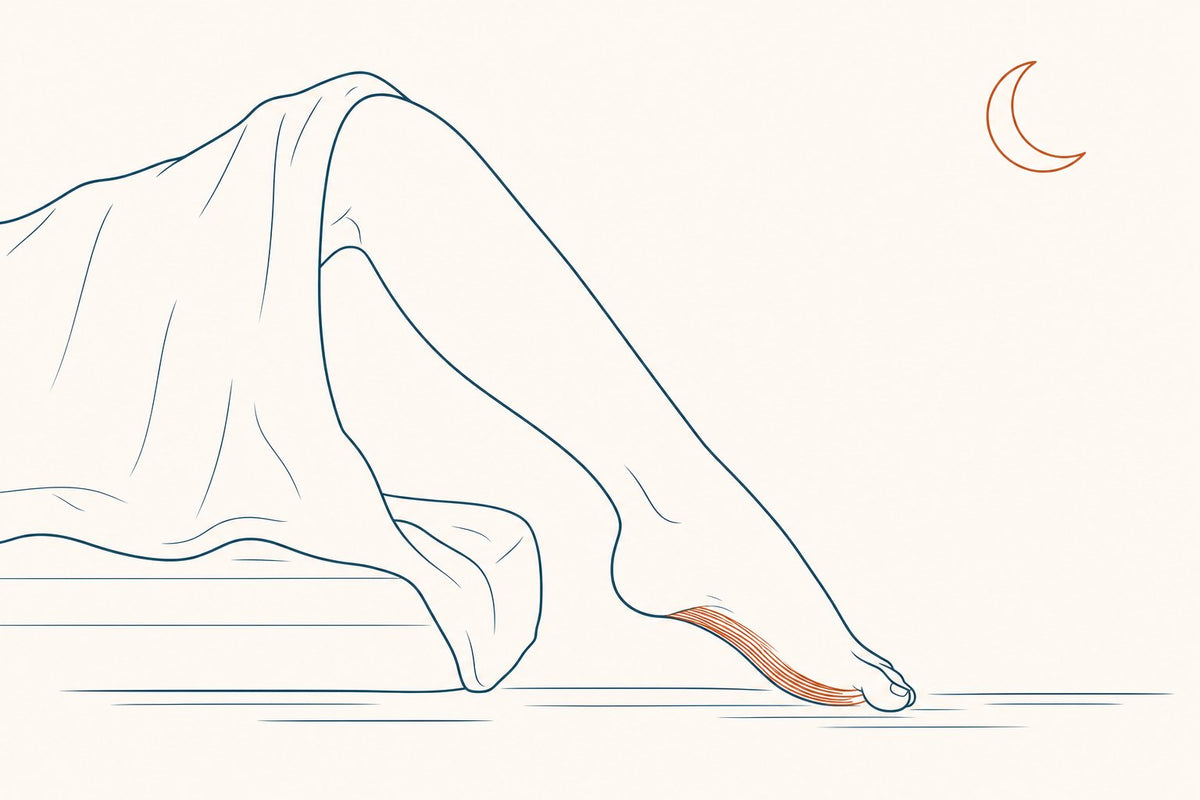
For many people with plantar fasciitis, the first steps out of bed hurt most because the foot spends the night pointed down, so the band of tissue under the arch rests slack and shortened. The first step then loads it with your full weight all at once.
What the plantar fascia does
The plantar fascia is a strong band of tissue on the bottom of your foot. It connects the heel bone to the front of the foot and supports the arch [1]. Every step you take puts tension on it.
Plantar fasciitis is a problem at the spot where that band attaches to the heel. The name suggests inflammation, and some patient pages still describe it that way [1]. Tissue studies point elsewhere. When researchers examined samples from 50 people who had surgery for long-lasting heel pain, they found worn, degenerated tissue without inflammation [2]. A 2019 review written for family doctors describes the condition the same way [3].
What happens overnight
Most people sleep with their feet pointed down. The American Academy of Orthopaedic Surgeons says this position relaxes the plantar fascia, and it names this as one of the reasons for morning heel pain [1].
The calf muscles are involved too. They pull on the heel from behind, and they also rest short when the foot points down. That is why splints worn at night are built to hold the ankle at a right angle or bent slightly upward, which keeps the calf and the plantar fascia at a longer length during sleep [3][4].
So for hours, the sore tissue sits short and still. Then you stand up.
Why the first step is the worst one
Standing puts your body weight through the arch. Tissue that rested short all night is pulled long in a moment, right at its sore attachment on the heel.
Clinicians treat this pattern as the hallmark of the condition. The 2019 review calls pain with the first step of the morning the classic presentation [3]. The clinical guideline used by physical therapists lists heel pain that is most noticeable with the first steps after a period of inactivity as a key sign [5].
The first step hurts most because tissue that rested slack all night is suddenly asked to carry your full weight.
This is the standard explanation, and it fits what people feel. It is not the whole story. Researchers still describe the way plantar fasciitis develops as poorly understood [6].
Why it eases after a few minutes
The pain usually starts when you begin walking after rest, then improves or fades as you keep moving [3]. The NHS describes the same thing: pain that is much worse when you first start walking after sleeping or resting, and gradually better once you are moving around [7].
Easing off does not mean the problem is gone. The same sources note that the pain tends to return later in the day, as time on your feet adds up [3][4].
Why it comes back after sitting
Morning is simply the longest rest of the day. A long drive, a movie or an hour at a desk does the same thing on a smaller scale. The foot rests, and the first steps afterward hurt. Guidelines describe the pain as coming on after any period of rest or inactivity, not only after sleep [4][5].
What this means for your mornings
If the trouble starts with tissue that rests short and is then loaded suddenly, two ideas follow. Both have been studied.
- Stretch before you stand. A 2003 trial of 101 people with long-lasting heel pain compared a plantar fascia stretch with a standard calf stretch. People in the plantar fascia group were encouraged to stretch before putting weight on the foot. After eight weeks, they had better scores for first-step pain [8][9].
- Keep the foot from pointing down overnight. This is the idea behind night splints. The 2023 guideline recommends a 1- to 3-month night splint program for people who consistently have pain with the first step in the morning [5]. The trial results are mixed, and we lay out both sides on our evidence page.
Neither one is a quick fix. Both aim at the same thing, which is a first step that is less of a shock to the tissue.
When to see a clinician
Morning heel pain is often plantar fasciitis, but not always. Heel pain can also come from nerves, joints, bone, infection or blood vessels [4]. Get checked if any of these apply:
- The pain started with an injury, a fall or a pop in the foot
- Numbness, tingling or burning in the foot
- Swelling, redness, warmth or a fever
- Pain at night while you are resting
- You have diabetes or circulation problems
- The pain is getting worse, or it stops you from doing normal activities
- No improvement after 6–8 weeks of steady home care
The Dawnstep Morning Relief Kit puts these at-home steps in one box: a soft night splint, gel heel cups, a massage ball and a 30-day plan. See what's in the kit.
Sources
- American Academy of Orthopaedic Surgeons. Plantar Fasciitis and Bone Spurs. OrthoInfo. OrthoInfo
- Lemont H, Ammirati KM, Usen N. Plantar fasciitis: a degenerative process (fasciosis) without inflammation. J Am Podiatr Med Assoc. 2003;93(3):234–237. PubMed
- Trojian T, Tucker AK. Plantar Fasciitis. Am Fam Physician. 2019;99(12):744–750. AAFP
- Thomas JL, Christensen JC, Kravitz SR, et al. The diagnosis and treatment of heel pain: a clinical practice guideline-revision 2010. J Foot Ankle Surg. 2010;49(3 Suppl):S1–S19. PubMed
- Koc TA Jr, Bise CG, Neville C, Carreira D, Martin RL, McDonough CM. Heel Pain - Plantar Fasciitis: Revision 2023. J Orthop Sports Phys Ther. 2023;53(12):CPG1–CPG39. PubMed
- Wearing SC, Smeathers JE, Urry SR, Hennig EM, Hills AP. The pathomechanics of plantar fasciitis. Sports Med. 2006;36(7):585–611. PubMed
- NHS. Plantar fasciitis. Page last reviewed 14 February 2025. NHS
- DiGiovanni BF, Nawoczenski DA, Lintal ME, Moore EA, Murray JC, Wilding GE, Baumhauer JF. Tissue-specific plantar fascia-stretching exercise enhances outcomes in patients with chronic heel pain. A prospective, randomized study. J Bone Joint Surg Am. 2003;85(7):1270–1277. PubMed
- DiGiovanni BF, Nawoczenski DA, Malay DP, Graci PA, Williams TT, Wilding GE, Baumhauer JF. Plantar fascia-specific stretching exercise improves outcomes in patients with chronic plantar fasciitis. A prospective clinical trial with two-year follow-up. J Bone Joint Surg Am. 2006;88(8):1775–1781. PubMed
This article is general information, not medical advice. Dawnstep is not affiliated with or endorsed by the organizations or authors cited.
Keep reading
 Night splints for plantar fasciitis: what the research says
A guideline recommends night splints for steady first-step pain, but the trials are small and mixed. An honest look at what was tested and what was found.
Read the article
Night splints for plantar fasciitis: what the research says
A guideline recommends night splints for steady first-step pain, but the trials are small and mixed. An honest look at what was tested and what was found.
Read the article
 The 2-minute stretch to do before you get out of bed
Step-by-step instructions for the plantar fascia stretch tested in a 2003 clinical trial, plus a calf stretch and a ball roll, and what to expect.
Read the article
The 2-minute stretch to do before you get out of bed
Step-by-step instructions for the plantar fascia stretch tested in a 2003 clinical trial, plus a calf stretch and a ball roll, and what to expect.
Read the article
 Heel spur or plantar fasciitis: what is the difference?
Heel spurs are common in people with no pain, and a spur on an X-ray is usually not why a heel hurts. What studies show and what it means for home care.
Read the article
Heel spur or plantar fasciitis: what is the difference?
Heel spurs are common in people with no pain, and a spur on an X-ray is usually not why a heel hurts. What studies show and what it means for home care.
Read the article