
Night splints for plantar fasciitis: what the research says
Every claim in this article is linked to a published source, listed at the end.
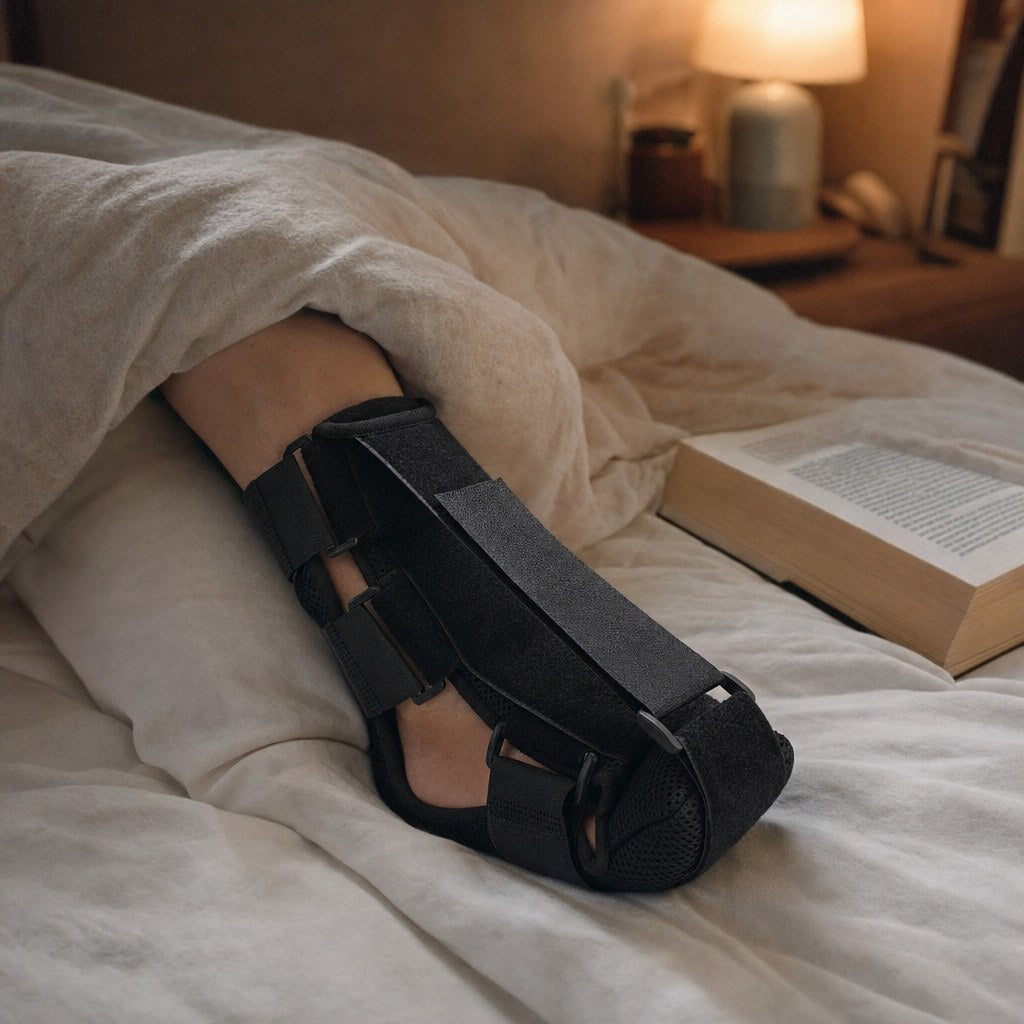
Night splints are recommended in the main physical therapy guideline for people whose heel pain is consistently worst with the first steps in the morning. The trials behind that advice are small and they disagree: some found a clear benefit, and others found no added benefit over stretching and standard care.
What a night splint is for
Most people sleep with their feet pointed down, which lets the plantar fascia rest in a relaxed position [1]. A night splint holds the ankle at a right angle or bent slightly upward during sleep, so the calf does not tighten up overnight [2]. The goal is a less painful first step. It is not a cure.
What the 2023 guideline says
The clinical practice guideline for heel pain in the Journal of Orthopaedic & Sports Physical Therapy was revised in 2023. Its wording is direct. Clinicians should prescribe a 1- to 3-month program of night splints for people with plantar fasciitis who consistently have pain with the first step in the morning [3].
One detail matters. The recommendation is aimed at people with steady first-step pain, not at everyone with a sore heel.
Other reviewers are more cautious. A 2019 review in American Family Physician describes the evidence on night splints as conflicting and says more studies are needed [2].
Trials that found a benefit
- A 1998 crossover trial followed 37 people with long-lasting plantar fasciitis who wore a splint for one month and used no other treatment. Of those who finished, 88% improved, and the gains held through the end of the six-month study [4].
- A 1996 trial of 40 people added a custom splint to a heel cushion, calf stretching and anti-inflammatory medicine. All 16 feet in the splint group got back to normal activity with little or no discomfort, compared with 6 of 17 in the group without a splint [5].
- A 2012 trial of 28 people paired a soft, adjustable splint with a shoe insert. That group had lower pain scores at two and eight weeks. The group using the insert alone did not change significantly [6].
Trials that found no added benefit
- The largest of these trials, published in 1999, enrolled 116 people. Everyone received anti-inflammatory medicine, calf stretches and shoe advice, and one group also wore a splint for three months. Overall, 68% improved by 12 weeks. The splint made no measurable difference [7].
- A 2017 trial of 40 people, whose pain had lasted about two years on average, compared a home exercise program with and without a splint. Both groups improved by about 1.5 points on a 10-point pain scale at three months. There was little or no difference between them [8].
In 2006, researchers assigned 43 people to shoe inserts, night splints or both. All three groups improved. At one year, the groups using inserts had a larger drop in pain, 62% compared with 48% for splints alone [9].
Night splints have guideline support for steady morning pain, but the trials are small and split, so they are worth a fair try and not a promise.
Rigid or soft
These trials used different designs: custom-fitted splints worn behind the calf and heel, splints worn on the front of the shin and foot, and off-the-shelf models [5][8][9]. Only the 2012 trial describes its splint as soft [6]. We did not find a trial that compares a soft splint head to head with a rigid one, so we cannot say the two work equally well.
What the research does show is that design affects comfort. A preliminary 2012 study compared a posterior splint, which pulls the foot upward, with an anterior splint that holds the foot at a right angle. Two-thirds of all participants said morning pain and stiffness were less. The posterior splint was more uncomfortable and disrupted sleep, and the authors called night splints poorly tolerated overall [10].
Comfort and sticking with it
A splint can only help on the nights you wear it. In the 2006 trial, people reported better compliance and fewer side effects with shoe inserts than with splints [9]. On the other hand, the 2017 trial measured sleep quality and found no significant worsening in the splint group [8].
Who they may suit, and for how long
Going by the guideline, a night splint is most worth trying if your pain is reliably at its worst with the first steps in the morning [3]. The recommended program is one to three months, which matches the length of the trials above. In the 1998 trial, the response did not depend on foot type, body weight or whether a heel spur showed on an X-ray [4].
If you try one, give it several weeks and keep up your daily stretching. Stop if it causes numbness, tingling or new pain. People with diabetes, poor circulation or reduced feeling in the feet should ask a clinician first. See a clinician as well if your heel pain is not improving after 6–8 weeks.
The Dawnstep Morning Relief Kit includes a soft night splint, along with gel heel cups, a massage ball and a 30-day plan. As described above, soft splints have less research behind them than rigid ones. See what's in the kit.
Sources
- American Academy of Orthopaedic Surgeons. Plantar Fasciitis and Bone Spurs. OrthoInfo. OrthoInfo
- Trojian T, Tucker AK. Plantar Fasciitis. Am Fam Physician. 2019;99(12):744–750. AAFP
- Koc TA Jr, Bise CG, Neville C, Carreira D, Martin RL, McDonough CM. Heel Pain - Plantar Fasciitis: Revision 2023. J Orthop Sports Phys Ther. 2023;53(12):CPG1–CPG39. PubMed
- Powell M, Post WR, Keener J, Wearden S. Effective treatment of chronic plantar fasciitis with dorsiflexion night splints: a crossover prospective randomized outcome study. Foot Ankle Int. 1998;19(1):10–18. PubMed
- Batt ME, Tanji JL, Skattum N. Plantar fasciitis: a prospective randomized clinical trial of the tension night splint. Clin J Sport Med. 1996;6(3):158–162. PubMed
- Lee WC, Wong WY, Kung E, Leung AK. Effectiveness of adjustable dorsiflexion night splint in combination with accommodative foot orthosis on plantar fasciitis. J Rehabil Res Dev. 2012;49(10):1557–1564. PubMed
- Probe RA, Baca M, Adams R, Preece C. Night splint treatment for plantar fasciitis. A prospective randomized study. Clin Orthop Relat Res. 1999;(368):190–195. PubMed
- Wheeler PC. The addition of a tension night splint to a structured home rehabilitation programme in patients with chronic plantar fasciitis does not lead to significant additional benefits in either pain, function or flexibility: a single-blinded randomised controlled trial. BMJ Open Sport Exerc Med. 2017;3(1):e000234. PubMed
- Roos E, Engström M, Söderberg B. Foot orthoses for the treatment of plantar fasciitis. Foot Ankle Int. 2006;27(8):606–611. PubMed
- Attard J, Singh D. A comparison of two night ankle-foot orthoses used in the treatment of inferior heel pain: a preliminary investigation. Foot Ankle Surg. 2012;18(2):108–110. PubMed
This article is general information, not medical advice. Dawnstep is not affiliated with or endorsed by the organizations or authors cited.
Keep reading
 Why heel pain is worst with your first steps in the morning
Overnight, the foot rests pointed down and the tissue under the arch rests short. The first step loads it all at once. Here is what the research says.
Read the article
Why heel pain is worst with your first steps in the morning
Overnight, the foot rests pointed down and the tissue under the arch rests short. The first step loads it all at once. Here is what the research says.
Read the article
 The 2-minute stretch to do before you get out of bed
Step-by-step instructions for the plantar fascia stretch tested in a 2003 clinical trial, plus a calf stretch and a ball roll, and what to expect.
Read the article
The 2-minute stretch to do before you get out of bed
Step-by-step instructions for the plantar fascia stretch tested in a 2003 clinical trial, plus a calf stretch and a ball roll, and what to expect.
Read the article
 Heel spur or plantar fasciitis: what is the difference?
Heel spurs are common in people with no pain, and a spur on an X-ray is usually not why a heel hurts. What studies show and what it means for home care.
Read the article
Heel spur or plantar fasciitis: what is the difference?
Heel spurs are common in people with no pain, and a spur on an X-ray is usually not why a heel hurts. What studies show and what it means for home care.
Read the article