
Heel spur or plantar fasciitis: what is the difference?
Every claim in this article is linked to a published source, listed at the end.
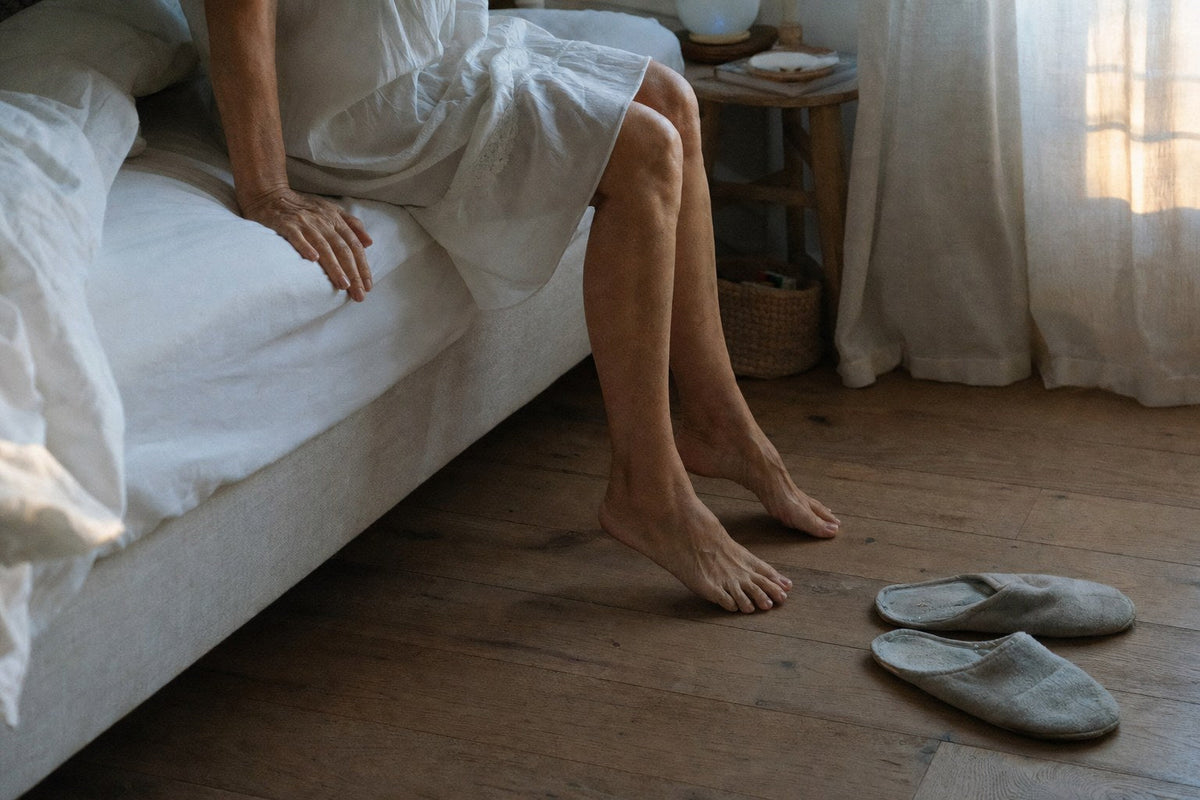
A heel spur is a bony growth on the heel bone that shows up on an X-ray, while plantar fasciitis is a painful problem in the band of tissue attached to that bone. Many people have a spur and no pain at all, and orthopedic sources say the spur is usually not what hurts.
Two different things
The plantar fascia is a band of tissue that runs from the heel bone to the front of the foot and supports the arch. Plantar fasciitis is pain near where that band meets the heel, often worst with the first steps in the morning [1].
A heel spur is a bony outgrowth on the underside of the heel bone [2]. It is a finding on an image. It does not, by itself, explain why a heel hurts.
Spurs are common in people with no pain
Earlier X-ray studies found heel spurs in roughly 11% to 16% of the general population. They are more common in older people. In a study of 216 people aged 62 to 94, 55% had at least one [3].
Most of those spurs were silent. In that study, 61% of the people with a spur had no heel pain, now or in the past [3]. The American Academy of Orthopaedic Surgeons puts it plainly: most people who have bone spurs on their heels do not have heel pain [1]. A review for family doctors calls a spur a common incidental finding in people without symptoms [4].
Spurs and heel pain do show up together
This is the part that confuses people. Spurs are more common in people with heel pain. A 2012 study compared X-rays of 19 people with plantar fasciitis and 19 people of the same age and sex with ankle sprains. Spurs appeared in 89% of the plantar fasciitis group and 32% of the comparison group [5].
That is a link, not proof of cause. The authors of that study said more research was needed to tell whether the spur causes anything [5]. The study of older adults found that spurs were also tied to obesity and osteoarthritis, and its authors suggested a spur may be the bone's response to pressure on the heel [3]. The same forces that load the heel may produce both the spur and the pain.
Location matters too. Anatomy studies cited in that paper found that most spurs sit deep to the plantar fascia, in the muscle attachments above it, and not in the fascia itself [3].
A spur does not seem to change recovery
If spurs were the source of the pain, people with spurs should do worse. Studies do not show that.
- A Danish study followed 174 people with plantar fasciitis for 5 to 15 years. Having a spur at the start had no effect on how they did. Among those who became pain-free, 64% still had a spur on that foot [6].
- In a study of 105 people treated without surgery, the presence or size of a spur did not influence the outcome [7].
- In a trial of 116 people, improvement rates were no different with or without a spur [8].
This is why the AAOS says plantar fasciitis pain can be treated without removing the spur, and why surgeons usually leave the spur alone even when they do operate [1].
A spur on your X-ray is common, often painless, and usually not the reason your heel hurts.
What this means for at-home care
For many people, the plan is the same with or without a spur. The physical therapy guideline recommends plantar fascia and calf stretching, and a night splint program of one to three months for people with consistent first-step pain in the morning [9]. The AAOS also lists cushioned, supportive shoes and soft heel pads, which raise and cushion the heel [1].
An X-ray is still useful. Its main job is to rule out other causes of heel pain, such as a fracture or arthritis [1].
There are exceptions. Researchers note that a very large spur, a broken spur or a trapped nerve near the spur may explain pain in some people [3]. That is a call for a clinician to make after an exam.
When to see a clinician
Heel pain can have causes other than the plantar fascia, including nerve, joint, bone and circulation problems [10]. The NHS advises seeing a doctor for several of the signs below [11]. Get checked if any of these apply:
- The pain started with an injury, a fall or a pop in the foot
- Numbness, tingling or burning in the foot
- Swelling, redness, warmth or a fever
- Pain at night while you are resting
- You have diabetes or circulation problems
- The pain is getting worse
- No improvement after 6–8 weeks of steady home care
The Dawnstep Morning Relief Kit puts these at-home steps in one box: a soft night splint, gel heel cups, a massage ball and a 30-day plan. See what's in the kit.
Sources
- American Academy of Orthopaedic Surgeons. Plantar Fasciitis and Bone Spurs. OrthoInfo. OrthoInfo
- Kirkpatrick J, Yassaie O, Mirjalili SA. The plantar calcaneal spur: a review of anatomy, histology, etiology and key associations. J Anat. 2017;230(6):743–751. PubMed
- Menz HB, Zammit GV, Landorf KB, Munteanu SE. Plantar calcaneal spurs in older people: longitudinal traction or vertical compression? J Foot Ankle Res. 2008;1(1):7. PubMed
- Trojian T, Tucker AK. Plantar Fasciitis. Am Fam Physician. 2019;99(12):744–750. AAFP
- Johal KS, Milner SA. Plantar fasciitis and the calcaneal spur: Fact or fiction? Foot Ankle Surg. 2012;18(1):39–41. PubMed
- Hansen L, Krogh TP, Ellingsen T, Bolvig L, Fredberg U. Long-Term Prognosis of Plantar Fasciitis: A 5- to 15-Year Follow-up Study of 174 Patients With Ultrasound Examination. Orthop J Sports Med. 2018;6(3):2325967118757983. PubMed
- Davis PF, Severud E, Baxter DE. Painful heel syndrome: results of nonoperative treatment. Foot Ankle Int. 1994;15(10):531–535. PubMed
- Probe RA, Baca M, Adams R, Preece C. Night splint treatment for plantar fasciitis. A prospective randomized study. Clin Orthop Relat Res. 1999;(368):190–195. PubMed
- Koc TA Jr, Bise CG, Neville C, Carreira D, Martin RL, McDonough CM. Heel Pain - Plantar Fasciitis: Revision 2023. J Orthop Sports Phys Ther. 2023;53(12):CPG1–CPG39. PubMed
- Thomas JL, Christensen JC, Kravitz SR, et al. The diagnosis and treatment of heel pain: a clinical practice guideline-revision 2010. J Foot Ankle Surg. 2010;49(3 Suppl):S1–S19. PubMed
- NHS. Plantar fasciitis. Page last reviewed 14 February 2025. NHS
This article is general information, not medical advice. Dawnstep is not affiliated with or endorsed by the organizations or authors cited.
Keep reading
 Why heel pain is worst with your first steps in the morning
Overnight, the foot rests pointed down and the tissue under the arch rests short. The first step loads it all at once. Here is what the research says.
Read the article
Why heel pain is worst with your first steps in the morning
Overnight, the foot rests pointed down and the tissue under the arch rests short. The first step loads it all at once. Here is what the research says.
Read the article
 Night splints for plantar fasciitis: what the research says
A guideline recommends night splints for steady first-step pain, but the trials are small and mixed. An honest look at what was tested and what was found.
Read the article
Night splints for plantar fasciitis: what the research says
A guideline recommends night splints for steady first-step pain, but the trials are small and mixed. An honest look at what was tested and what was found.
Read the article
 The 2-minute stretch to do before you get out of bed
Step-by-step instructions for the plantar fascia stretch tested in a 2003 clinical trial, plus a calf stretch and a ball roll, and what to expect.
Read the article
The 2-minute stretch to do before you get out of bed
Step-by-step instructions for the plantar fascia stretch tested in a 2003 clinical trial, plus a calf stretch and a ball roll, and what to expect.
Read the article