
The 2-minute stretch to do before you get out of bed
Every claim in this article is linked to a published source, listed at the end.
The stretch below comes from a clinical trial of people with long-lasting heel pain. Sitting on the edge of the bed, you cross the sore foot over your other knee, pull the toes back toward your shin, hold for a count of 10 and repeat 10 times, all before your first step.
Where this stretch comes from
In 2003, researchers at the University of Rochester ran a trial with 101 people who had had heel pain for at least ten months. One group was taught a stretch aimed at the plantar fascia itself. The other was taught a standard calf stretch. Everyone also received soft insoles, a three-week course of an anti-inflammatory medicine and an educational video [1].
After eight weeks, 82 people came back for follow-up. Both groups had improved, but the plantar fascia group had better scores for their worst pain and for pain with the first steps in the morning [1][2].
Two years later, 66 of those people answered a follow-up survey. By then everyone had been taught the plantar fascia stretch. In that survey, 94% reported less pain, and 92% were fully satisfied or satisfied with minor reservations. The two original groups no longer differed [2].
The authors were open about the limits. There was no untreated comparison group, and about one in five people dropped out at each stage, so the results cannot be credited to the stretch with certainty [2]. Even so, the current physical therapy guideline recommends both plantar fascia-specific stretching and calf stretching for heel pain [3].
The stretch, step by step
Do this sitting on the edge of the bed, before you stand [2][4].
- Cross the sore foot over the knee of your other leg.
- Place your fingers across the base of your toes.
- Pull the toes back toward your shin until you feel a stretch in the arch.
- With your other hand, rub gently across the arch. The band should feel firm, like a guitar string. That tells you the stretch is in the right place.
- Hold for a count of 10, then relax.
- Repeat 10 times.
Ten holds of ten seconds comes to a little under two minutes. If reaching your foot is hard, the American Academy of Orthopaedic Surgeons suggests wrapping a towel around the big toe to help pull the toes toward you [5].
The timing is part of the method: the first round goes before the first step of the day.
How often
In the trial, people did the stretch three times a day, with the first round before the first step of the morning. They were asked to keep it up for at least eight weeks [2]. The University of Rochester patient sheet names the two most important times: before the first step in the morning, and before standing after a long period of sitting [4].
Add a calf stretch
Tight calf muscles put extra stress on the plantar fascia [5], and the guideline recommends stretching both [3]. For a version you can do in bed, sit with your leg straight, loop a towel around the ball of your foot and pull it toward you. Hold for 30 seconds, then relax for 30 seconds [6].
Once you are up, there is a standing version. Lean against a wall with the sore leg behind you, knee straight and heel on the floor, and the other leg in front with the knee bent. Push your hips toward the wall, hold for 10 seconds and relax [5].
Roll the foot on a ball
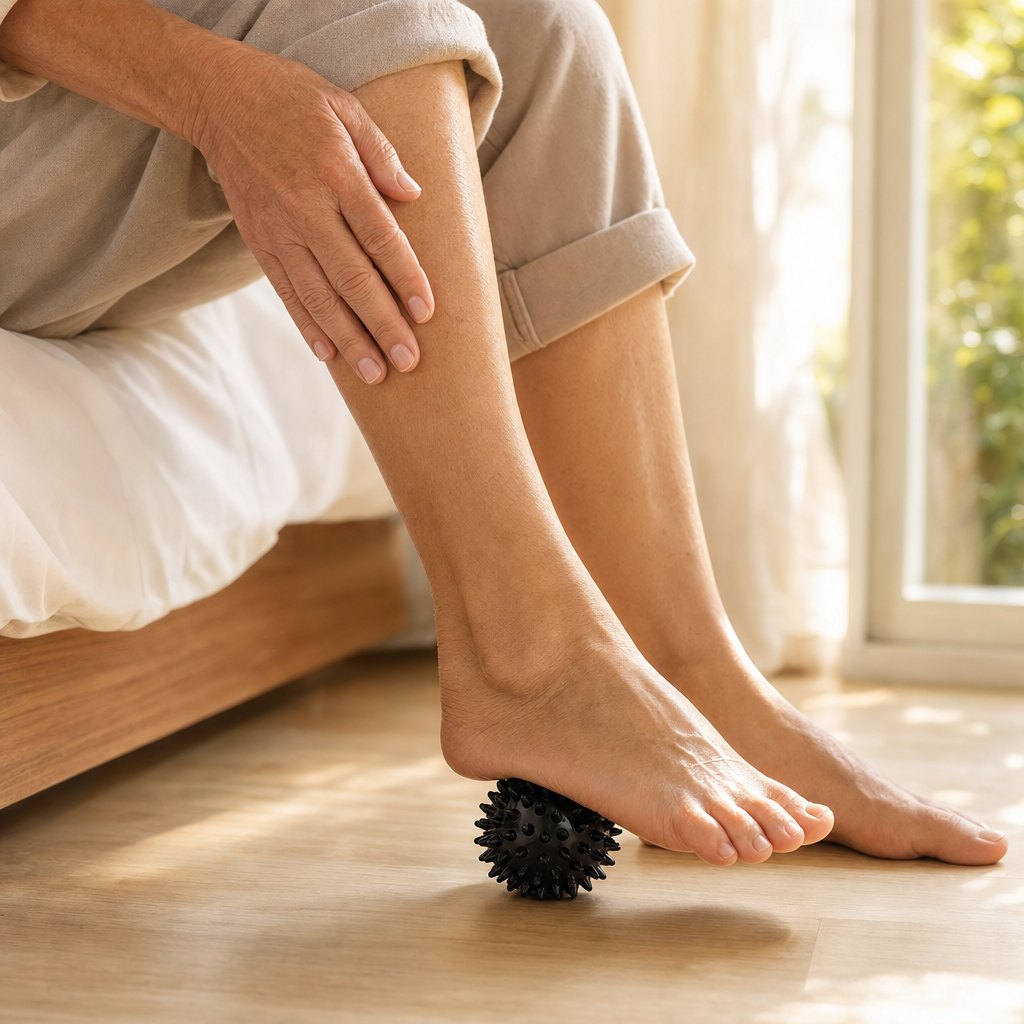
The AAOS foot and ankle conditioning program includes a simple roll. Sit with both feet on the floor and roll a ball under the arch of the sore foot for two minutes. A golf ball, a tennis ball or a frozen water bottle will do [6].
The evidence here is thinner. The trials above tested the toe stretch, not ball rolling, so treat the ball as an add-on and not a replacement.
What to expect
You should feel a firm pull in the arch, not sharp pain. Ease off if it hurts.
Do not expect a change in the first few days. The trial measured results at eight weeks. In the two-year follow-up, 62% of people said they reached their best results within six months of starting [2]. The study tested a daily habit kept up for weeks, so steady repetition matters more than any single session.
See a clinician if the pain followed an injury, if you have numbness, tingling, swelling or fever, or if nothing has changed after 6–8 weeks.
Dawnstep's free 30-day guide lays out this routine day by day. Read the guide.
Sources
- DiGiovanni BF, Nawoczenski DA, Lintal ME, Moore EA, Murray JC, Wilding GE, Baumhauer JF. Tissue-specific plantar fascia-stretching exercise enhances outcomes in patients with chronic heel pain. A prospective, randomized study. J Bone Joint Surg Am. 2003;85(7):1270–1277. PubMed
- DiGiovanni BF, Nawoczenski DA, Malay DP, Graci PA, Williams TT, Wilding GE, Baumhauer JF. Plantar fascia-specific stretching exercise improves outcomes in patients with chronic plantar fasciitis. A prospective clinical trial with two-year follow-up. J Bone Joint Surg Am. 2006;88(8):1775–1781. PubMed
- Koc TA Jr, Bise CG, Neville C, Carreira D, Martin RL, McDonough CM. Heel Pain - Plantar Fasciitis: Revision 2023. J Orthop Sports Phys Ther. 2023;53(12):CPG1–CPG39. PubMed
- University of Rochester Medical Center Orthopaedics. Plantar Fascia-Specific Stretching Program for Plantar Fasciitis. Patient teaching sheet. URMC
- American Academy of Orthopaedic Surgeons. Plantar Fasciitis and Bone Spurs. OrthoInfo. OrthoInfo
- American Academy of Orthopaedic Surgeons. Foot and Ankle Conditioning Program. OrthoInfo. OrthoInfo
This article is general information, not medical advice. Dawnstep is not affiliated with or endorsed by the organizations or authors cited.
Keep reading
 Why heel pain is worst with your first steps in the morning
Overnight, the foot rests pointed down and the tissue under the arch rests short. The first step loads it all at once. Here is what the research says.
Read the article
Why heel pain is worst with your first steps in the morning
Overnight, the foot rests pointed down and the tissue under the arch rests short. The first step loads it all at once. Here is what the research says.
Read the article
 Night splints for plantar fasciitis: what the research says
A guideline recommends night splints for steady first-step pain, but the trials are small and mixed. An honest look at what was tested and what was found.
Read the article
Night splints for plantar fasciitis: what the research says
A guideline recommends night splints for steady first-step pain, but the trials are small and mixed. An honest look at what was tested and what was found.
Read the article
 Heel spur or plantar fasciitis: what is the difference?
Heel spurs are common in people with no pain, and a spur on an X-ray is usually not why a heel hurts. What studies show and what it means for home care.
Read the article
Heel spur or plantar fasciitis: what is the difference?
Heel spurs are common in people with no pain, and a spur on an X-ray is usually not why a heel hurts. What studies show and what it means for home care.
Read the article