
How long plantar fasciitis lasts, and when to see a doctor
Every claim in this article is linked to a published source, listed at the end.
Most people with plantar fasciitis get better with simple, non-surgical care, but it usually takes months, not weeks. Reviews put the figure at about 80% improved within 12 months, and a smaller group has symptoms that last longer.
A realistic timeline
The numbers vary by source, so it helps to see them side by side.
- A 2019 review for family doctors states that about 80% of people improve within 12 months with non-surgical care [1].
- The American Academy of Orthopaedic Surgeons says more than 90% improve within 10 months of starting simple treatment [2].
- In a study of 105 people treated with a standard non-surgical plan, 89.5% had their heel pain resolve within about 11 months [3].
- A guideline from foot and ankle surgeons notes that people usually begin to respond within six weeks of starting treatment [4].
So the common pattern is a first change within weeks and steady progress over months.
The less comfortable numbers
Not everyone follows that curve. A Danish hospital clinic followed 174 people for 5 to 15 years. At follow-up, 46% still had some symptoms. The authors point out that this was a hard-to-treat group, and that the remaining pain was mostly mild, averaging 2.8 on a scale that runs to 10 [5].
An older study of 100 people, checked about four years after treatment, found 82 with no symptoms, 15 with symptoms that did not limit them, and 3 whose symptoms still limited activity or work [6].
The fair summary: most people recover, it often takes the better part of a year, and some have pain that lingers.
What tends to slow recovery
- Waiting a long time. In the four-year study, people who had symptoms for a long time before seeking care were more likely to still have them [6]. The surgeons' guideline says the same: the longer the pain has been there, the longer it tends to take to settle [4].
- Pain in both heels. Two long-term studies linked this to a slower course [5][6].
- Extra body weight. It was tied to continued symptoms in one study [6], though not in the Danish one [5].
What may help it along
The 2023 physical therapy guideline recommends plantar fascia and calf stretching, taping for short-term relief, and a 1- to 3-month night splint program for people with consistent first-step pain in the morning. It advises against using shoe inserts as a stand-alone treatment for short-term pain relief, and says they may be combined with other care [7].
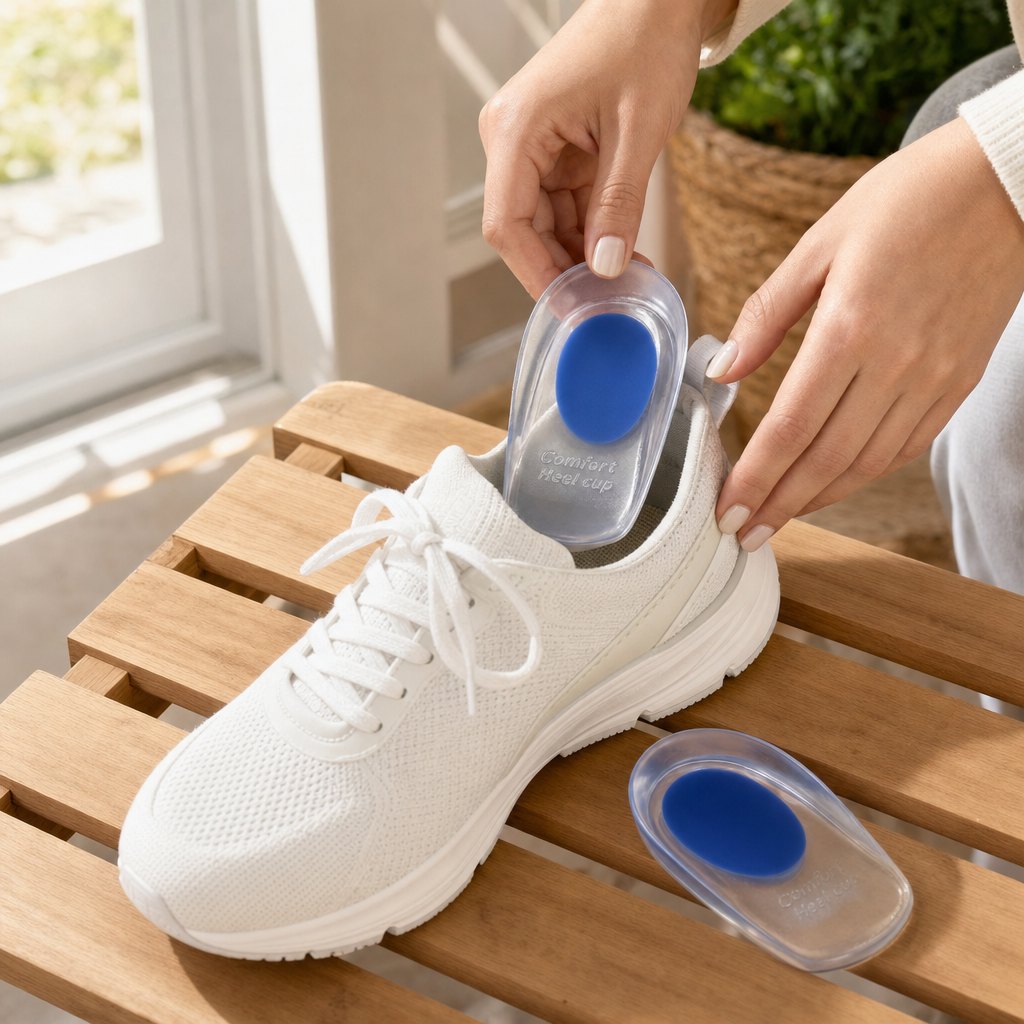
A 2019 review of 43 studies found that inserts, taping and night splints can each ease symptoms. Heel pads still have a place as simple cushioning. The NHS and the AAOS both list them among basic self-care steps [2][9].
The NHS adds the plain basics: rest the foot when you can, wear cushioned shoes with good arch support, avoid walking barefoot on hard surfaces, and lose weight if you are overweight [9].
None of these is a guaranteed shortcut. They are reasonable steps with some evidence behind them. More on that on our evidence page.
When to see a clinician
The NHS advises seeing a doctor if heel pain has not improved after two weeks of self-care, if it is severe, or if it keeps coming back [9]. It lists severe pain after an injury, a snap or pop, or being unable to walk as reasons to get urgent help [10]. The surgeons' guideline suggests a specialist visit when there is little or no improvement after about six weeks of treatment [4]. Get checked if any of these apply:
- The pain began with an injury, or you heard a snap or pop
- You cannot walk on the foot
- Numbness, tingling or burning in the foot
- Swelling, redness, warmth or a fever
- Pain at night while you are resting
- You have diabetes or circulation problems
- The pain is getting worse
- No improvement after 6–8 weeks of steady home care
What a clinician may offer next
- An exam, and sometimes imaging. Imaging is mainly used to look for other causes when pain lasts beyond three months and is not responding [1].
- Physical therapy. This may include hands-on treatment, taping and a guided exercise plan [7].
- A corticosteroid injection. It may give short-term relief. The risks include rupture of the plantar fascia [1][2].
- Shock wave therapy. Sources disagree. One review sees a role when other care has not worked, and the AAOS calls the results mixed [1][2].
- Surgery. Few people need it. It is generally saved for those who have not improved after 12 months of non-surgical care [2][4].
The Dawnstep Morning Relief Kit puts these at-home steps in one box: a soft night splint, gel heel cups, a massage ball and a 30-day plan. See what's in the kit.
Sources
- Trojian T, Tucker AK. Plantar Fasciitis. Am Fam Physician. 2019;99(12):744–750. AAFP
- American Academy of Orthopaedic Surgeons. Plantar Fasciitis and Bone Spurs. OrthoInfo. OrthoInfo
- Davis PF, Severud E, Baxter DE. Painful heel syndrome: results of nonoperative treatment. Foot Ankle Int. 1994;15(10):531–535. PubMed
- Thomas JL, Christensen JC, Kravitz SR, et al. The diagnosis and treatment of heel pain: a clinical practice guideline-revision 2010. J Foot Ankle Surg. 2010;49(3 Suppl):S1–S19. PubMed
- Hansen L, Krogh TP, Ellingsen T, Bolvig L, Fredberg U. Long-Term Prognosis of Plantar Fasciitis: A 5- to 15-Year Follow-up Study of 174 Patients With Ultrasound Examination. Orthop J Sports Med. 2018;6(3):2325967118757983. PubMed
- Wolgin M, Cook C, Graham C, Mauldin D. Conservative treatment of plantar heel pain: long-term follow-up. Foot Ankle Int. 1994;15(3):97–102. PubMed
- Koc TA Jr, Bise CG, Neville C, Carreira D, Martin RL, McDonough CM. Heel Pain - Plantar Fasciitis: Revision 2023. J Orthop Sports Phys Ther. 2023;53(12):CPG1–CPG39. PubMed
- Schuitema D, Greve C, Postema K, Dekker R, Hijmans JM. Effectiveness of Mechanical Treatment for Plantar Fasciitis: A Systematic Review. J Sport Rehabil. 2020;29(5):657–674. PubMed
- NHS. Plantar fasciitis. Page last reviewed 14 February 2025. NHS
- NHS. Heel pain. Page last reviewed 24 October 2025. NHS
This article is general information, not medical advice. Dawnstep is not affiliated with or endorsed by the organizations or authors cited.
Keep reading
 Why heel pain is worst with your first steps in the morning
Overnight, the foot rests pointed down and the tissue under the arch rests short. The first step loads it all at once. Here is what the research says.
Read the article
Why heel pain is worst with your first steps in the morning
Overnight, the foot rests pointed down and the tissue under the arch rests short. The first step loads it all at once. Here is what the research says.
Read the article
 Night splints for plantar fasciitis: what the research says
A guideline recommends night splints for steady first-step pain, but the trials are small and mixed. An honest look at what was tested and what was found.
Read the article
Night splints for plantar fasciitis: what the research says
A guideline recommends night splints for steady first-step pain, but the trials are small and mixed. An honest look at what was tested and what was found.
Read the article
 The 2-minute stretch to do before you get out of bed
Step-by-step instructions for the plantar fascia stretch tested in a 2003 clinical trial, plus a calf stretch and a ball roll, and what to expect.
Read the article
The 2-minute stretch to do before you get out of bed
Step-by-step instructions for the plantar fascia stretch tested in a 2003 clinical trial, plus a calf stretch and a ball roll, and what to expect.
Read the article